← Case fileFrom genesis to the first transaction1 / 13
Turn your phone to see the sheet larger.
01
The story
Eight days, three moments
1
The chain begins
Block 0, the genesis, creates the first 50 BTC and stores a newspaper headline.
2
Only new coins
169 blocks in a row, each with a single transaction, the one that pays whoever mined it.
3
Someone spends
Block 170 holds the first transaction that spends a coin. A 50 BTC coin goes in and pays 10.
Between the genesis and block 1 there is a pause of 5 days and 8 hours. From 1 to 170, three days.
02
Before we start
Six words to read the chain
Block
A batch of transactions added to the chain. Each one points to the previous one. The first is the genesis.
Coinbase
The first transaction in every block. It creates new bitcoin for whoever mined the block, without spending any coin. In 2009, 50 BTC.
Transaction · TXID
A movement of coins. Its TXID is the 64-character number used to look it up.
Input
The coin a transaction spends. It is spent whole, like a banknote.
Output
A new coin the transaction creates, with its amount and its lock, which says who can spend it.
Change
What is left of the banknote, which goes back to the payer in a separate output, like the change from a purchase.
The outputs in this case are locked to a bare public key (this is called P2PK), with no address.
03
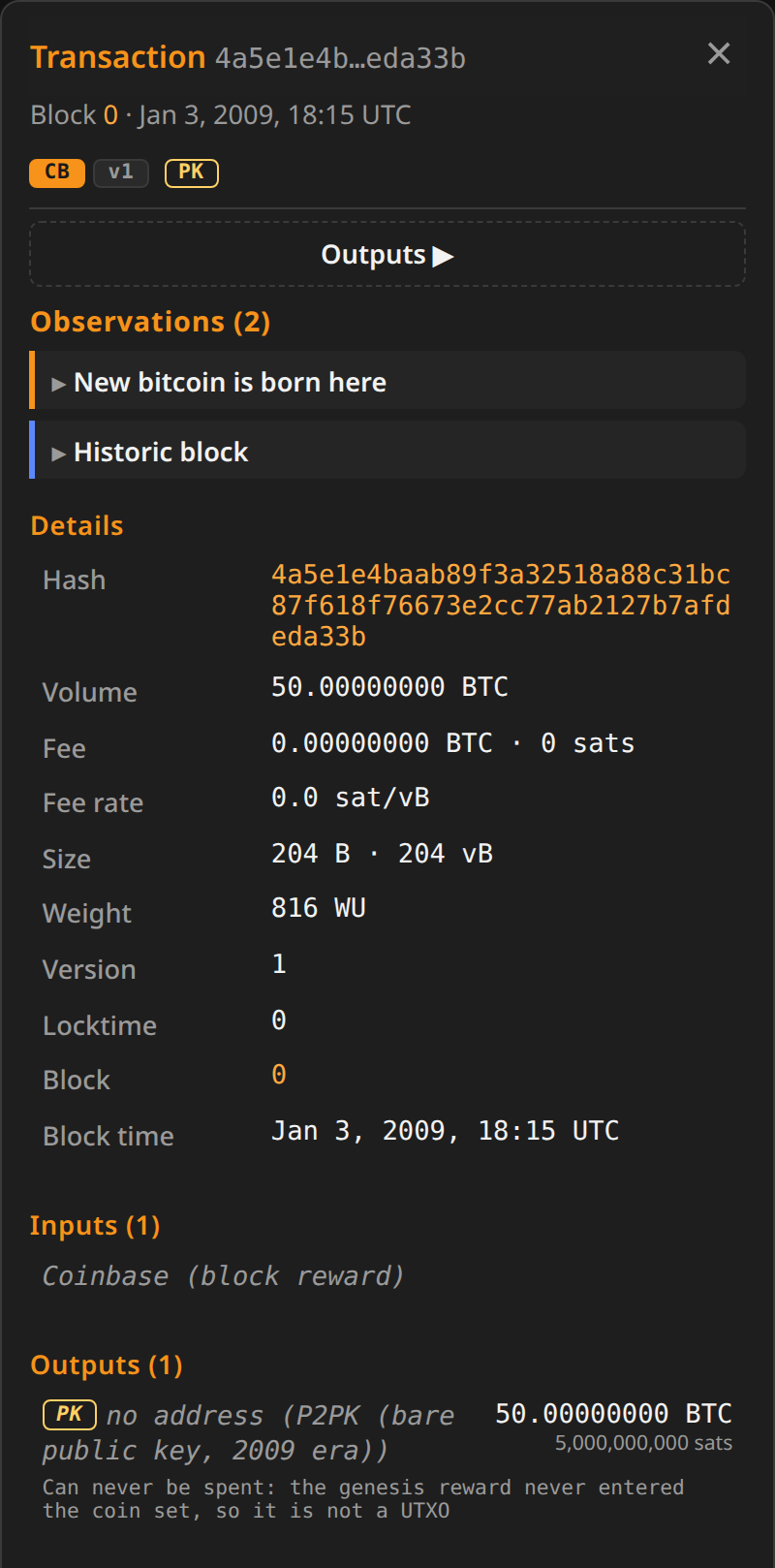
Jan 3, 2009, 18:15 UTC · Block 0
The genesis stores a headline
Inside the coinbase, where the miner can write anything, it says:
“The Times 03/Jan/2009 Chancellor on brink of second bailout for banks”
1transaction in the block, the coinbase
50 BTCcreated in a single output
0addresses; the lock is a public key
Neverspent
The chain stores the text. According to the Bitcoin Wiki, it is the front-page headline of the London Times that day and was probably put there as proof that the block was not built earlier.
04
The genesis
50 BTC that nobody can spend
It’s not that nobody wanted toThe software that validates the chain skips the genesis transactions. That output never entered the set of spendable coins.
It is written in the code// Special case for the genesis block, skipping connection of its transactions (its coinbase is unspendable) Bitcoin Core, validation.cpp
On purpose or by accident?It is not known.
Careful with explorersThey show it as “unspent”. Satsumap also marked it “UTXO” (an available coin), and it isn’t one. Since this case, it says it can’t be spent.
The chain shows that output was never spent. That it can’t be spent comes from the Bitcoin Core code.
05
1A1zP1…
Same key, different lock
People say “the genesis address keeps receiving bitcoin”. But the genesis output has no address. 1A1zP1eP5QGefi2DMPTfTL5SLmv7DivfNa is the address derived from the same public key, and it is a different lock.
Neither lock had spent anything as of Oct 9, 2026. The Bitcoin Wiki says the genesis paid “to the address 1A1zP1…”, but on the chain the payment is to the bare key.
06
January 9 to 12 · Blocks 1 to 169
For days, only new coins
5 d 8 hpause between the genesis and block 1 (Jan 9, 02:54 UTC)
169blocks with a single transaction, the coinbase
25.8 minbetween blocks on average (the design targets 10)
170different public keys in blocks 0 to 169, one per block
Each block pays 50 BTC to whoever mined it. Nobody sends anything to anybody.
THE PAUSE, DEBATED
What happened in those five days is not known. It has been said that the genesis was dated to match the headline, that it took days to mine, or that it was used for testing and the network started on the 9th, and none of the three is proven. Also, a block’s time is written by whoever mines it, and it may not be exact.
People often say “six days” because January 3 and 9 are six calendar days apart. Measured between the times of the two blocks, it is 5 days, 8 hours and 39 minutes.
07
Jan 12, 2009, 03:30 UTC · Block 170
The first coin is spent
1sttransaction on the chain that is not a coinbase
3 daysthe block 9 coin sat still
0fee; 50 in, 50 out
2 h 32 minlater, the change had already been spent (block 181)
TXID f4184fc596403b9d638783cf57adfe4c75c605f6356fbc91338530e9831e9e16. The first coin ever spent is one of the coins created by mining.
08
How it looks
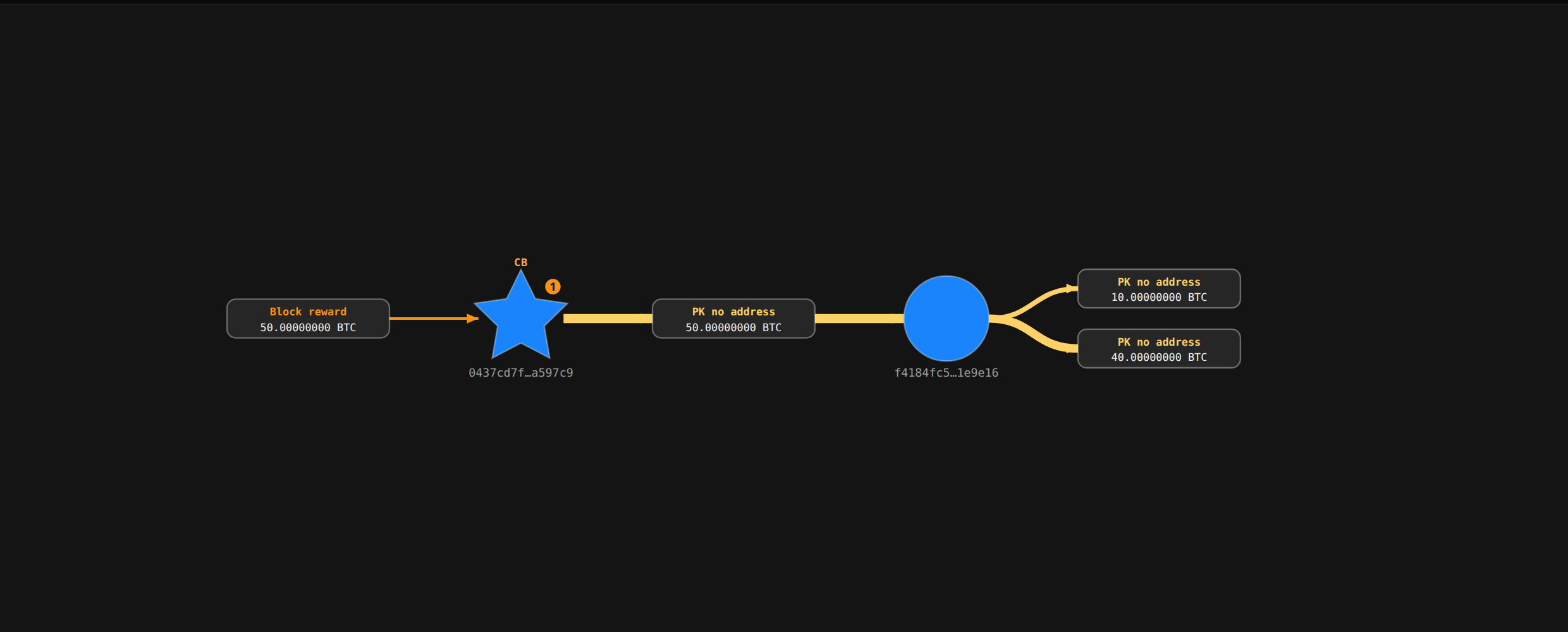
Block 170 in Satsumap
Star: a coinbaseThe one in block 9. To its left, where its 50 BTC come from, the block reward.
Circle: a transactionThe one in block 170. It spends the 50 coin and creates two, of 10 and 40. The “PK no address” tag marks a bare public key lock.
To explore it, go to satsumap.citadellhost.com, search for TXID f4184fc5…e9e16 and tap the tag on the left.
09
Who is who
The chain shows no names
WHAT THE CHAIN SHOWS
Public keysOne collected the block 9 reward and paid. Another, new one received 10 BTC.
Amounts and times50 in, 10 and 40 out, on Jan 12, 2009 at 03:30 UTC.
Nothing elseNo name, no country, no email.
WHAT HAL FINNEY SAID
“I was the recipient of the first bitcoin transaction, when Satoshi sent ten coins to me as a test.”
Hal Finney, “Bitcoin and me”, Bitcoin Talk forum, March 19, 2013.
Both names come from Hal’s account. Satoshi Nakamoto is a pseudonym. Who is behind it is not known, and this case does not speculate about it.
10
To this day
Of 170 coinbases, 2 were spent
8,400 BTCfrom the coinbases of blocks 0 to 169 had not moved as of Oct 9, 2026
Coinbase of block
Spent in
9
block 170 · Jan 12, 2009 · this case
78
block 130,667 · Jun 14, 2011
the other 168
unspent (as of Oct 9, 2026)
INFERENCE
Hal said he mined “block 70-something”. The coinbase of block 78 is the only one in that range that was spent. That fits with it being his. The chain only shows a key that collected 50 BTC and spent them two and a half years later.
IN CASE FILE 004
Who mined the rest? The Patoshi pattern is a widely cited inference about who mined most of these blocks. It is not proven.
The genesis 50 BTC are among the 8,400, and besides never having moved, they can’t be spent.
11
Read with care
What the chain says and what it doesn’t
Claim
Source
The genesis creates 50 BTC and stores “The Times 03/Jan/2009…”
Chain
That text is the Times headline of that day
Outside: Bitcoin Wiki
The genesis 50 BTC can’t be spent
Outside: the Bitcoin Core code
5 days and 8 hours pass between the genesis and block 1
Chain (time of each block)
Why there was that pause
Debated, no proof
From block 1 to 169, only coinbases
Chain
The first transaction that spends a coin is in block 170 and spends the block 9 coinbase
Chain
Satoshi paid it and Hal Finney received it
Outside: Hal Finney’s account (2013)
Hal mined block 78
Inference, not proven
Anyone can check what the chain says, with the TXIDs on the next sheet.
Each TXID and address opens Satsumap with one click, and next to it is the link to mempool.space. You can also copy them and paste them into either search box.
Sources outside the chain: Hal Finney, “Bitcoin and me”, Bitcoin Talk (Mar 19, 2013) · Bitcoin Core, src/validation.cpp · Bitcoin Wiki, “Genesis block”.